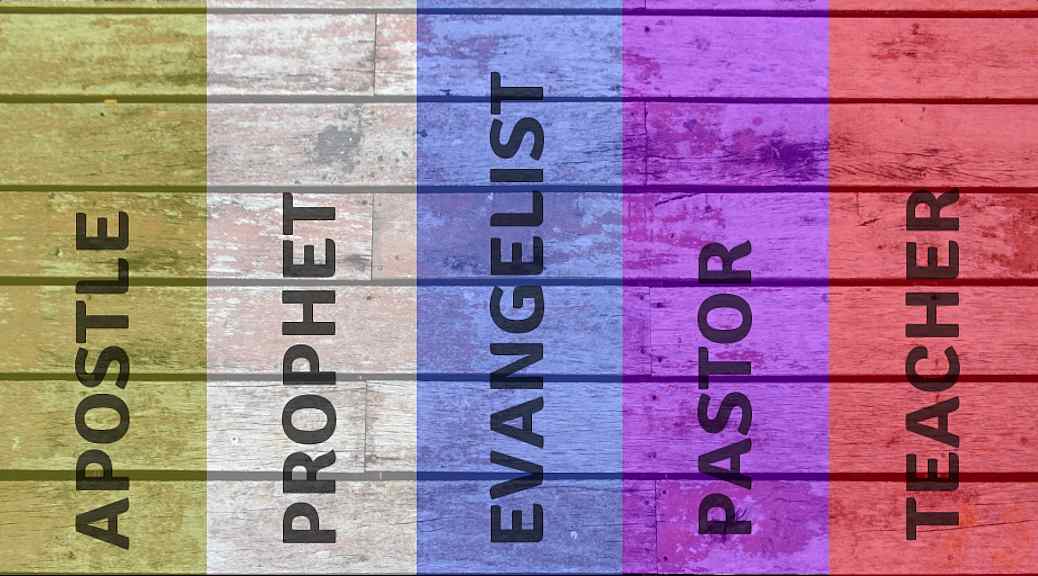
Session 3: The Five-Fold Ministry
Audio Version Of This Web Page
MP3 Player behaving funny? Try a different browser or a different device
The Five-Fold Ministries In House Churches
In this session, we are discussing the practical functions and roles of the five-fold ministries in house churches. What we see in the organized church, referring to the five-fold ministry, is not what it is supposed to be. The five-fold ministries operate and function in a completely different way in house churches. In reality, the five-fold ministries are all itinerant workers. They are constantly planting new house churches, and they are constantly visiting the house churches to help them grow and develop in Christ. They all work together. The apostles plant the house churches. The evangelists are involved with the gathering of the new converts but they are not really involved with the planting of churches or the development of the congregations. The prophets, teachers, and pastors are sometimes involved with the planting of the churches. They are always involved with the spiritual development and equipping process of the house church congregations.
The evangelists liaise with the apostles, pastors, prophets and teachers when he goes out on outreaches. There is no logic in leading people to Christ without incorporation them into house churches. This is why the evangelist liaises with the other members of the five-fold ministry. After his work is done, he hands over to the apostles, prophets, pastors and teachers who plant new house churches and who starts the process of teaching and developing the new converts and the new congregations. Sometimes the evangelist help existing congregations to expand by arranging evangelical outreaches in their areas.
So the apostles either do this without the help of an evangelist or they sometimes take the new converts over from them after an outreach. Whatever the case may be, it is the function of the apostle to lay the right foundation. He needs to make sure that he lays the same foundation that Jesus Christ did and the early apostles did.
To thoroughly understand the functions of an apostle, I need to explain the different types of apostles:
Ephesians 4:11-12
11 And he gave some, apostles; and some, prophets; and some, evangelists; and some, pastors and teachers;
12 For the perfecting of the saints, for the work of the ministry, for the edifying of the body of Christ.
What does the word apostle mean? It means a person who was sent. Sent to do what? Sent to put something in place. The first apostle that we need to know about is Jesus Christ. He was sent by the Father to put something in place. Jesus Christ was sent to plant the global or universal church.
The Apostle Jesus: So in a nutshell, an apostle is a person who plants churches and who teaches people how to function as a church or a congregation. Jesus Christ was the first Apostle ever sent and He is the first type or first level of apostle. We read about that in Hebrew 3:1
Wherefore, holy brethren, partakers of the heavenly calling, consider the Apostle and High Priest of our profession, Christ Jesus.
Jesus Christ is the only person that is part of the first type of apostle. He is the first and sole planter of the global church, and He was and still is involved and will be from start to finish.
Apostles of the Lamb: The second group or level of apostles were the twelve disciples. They were personally called by Jesus Christ when He was walking this earth and they were eyewitnesses of the ministry of Jesus Christ on earth and his crucifixion and resurrection. The Bible calls them the apostles of the Lamb in Revelation 21:14
And the wall of the city had twelve foundations, and in them the names of the twelve apostles of the Lamb.
Like Jesus Christ, they were known as fundamental apostles. This means that they have laid the foundation of the church. The easiest method to identify fundamental apostles is done by acknowledging the fact that they have played a major role in laying the right foundation for the first time in their area of influence when it comes to church planting and the development of the church. These apostles have written parts of the New-Testament or they have functioned according to those principles in a time that the New Testament was not officially available yet. So either by writing the New Testament or by teaching the early churches the same principles one-on-one by showing the early Christians how to lay the right foundation, extinguished them as fundamental apostles. They provided the know-how, either by on-the-job training or by writing material that later made up the New Testament.
Other Fundamental apostles:
This brings me to another level or group of apostles, and that is the other fundamental apostles of the New Testament. They were not part of the group called the apostles of the Lamb but there ministries were also fundamental pioneer work. These people were the third level of apostles and they were no different from the second level of apostles, except that they were not personally called by Christ whilst He was still walking this earth. They were also not eyewitnesses of his ministry on earth and his crucifixion and resurrection.
Some of them did write part of the New Testament like Paul, James, Mark, and Luke. So they were also teaching and showing people how to plant churches and how to develop the congregations and the church of Christ. The fundamental apostles were all inspired and taught by Christ Jesus and the Holy Spirit to make sure that the right foundation was laid. Although he did not right any of the Bible, Barnabas was also part of this group of apostles.
When the Bible refers to “the foundation that the apostles have laid” or to “the doctrines of the apostles”, it is referring to the work of the fundamental apostles, the level two, and level three apostles.
Acts 2:41-42
41 Then they that gladly received his word were baptized: and the same day there were added unto them about three thousand souls.
42 And they continued stedfastly in the apostles’ doctrine and fellowship, and in breaking of bread, and in prayers.
Non-fundamental apostles: Non-fundamental apostles are the house church planters of the Bible and everybody who plants house churches, even today. These were people like Apollos, Titus, Épafras, Timothy, Silas, Gajus, Aristárchus, Secúndus, Tíchikus, Trófimus, and Sópater and all Biblical-based house church planters. Even contemporary house church planters fall under this group. You may know one. These are all part of the fourth level of apostles.
They planted house churches exactly like Jesus Christ did and exactly as the fundamental apostles did. When a person is sent by the Holy Spirit to plant a new house church, that person is sent to implement exactly what Jesus Christ has implemented right in the beginning.
So an apostle is sent out to put something in place. He must go and plant house churches. He cannot plant a church like he wants to. He must plant it as Jesus did. He must lay the right foundation. Before an apostle can lay the right foundation he must know the right foundation. How do we know the right foundation? We must look at what the Great Apostle, Jesus Christ did, and at what the fundamental apostles did. If we stay with the doctrines of the fundamental apostles then we are planting pure house church congregations.
So what about all the apostles that we see in the organized church today? If they lay any other foundation than the foundation that Jesus Christ and the fundamental apostles have laid, then they are not truly Biblical apostles. A Biblical apostle plants house churches according to the structures and principles that have been discussed in this session and the previous sessions of this series.
So contemporary apostles stick with the doctrines of the early apostles, they plant churches like they did and they develop the congregations as they did. I have heard people say that the ministry of the apostle does not exist anymore. That it is something of the past. According to them, this function ceased even in Biblical times. That is not true. Does God still send people to plant churches? Does He expect from them to lay the right foundation? Does He expect from them to teach and develop the congregation according to the doctrines of the early or fundamental apostles?
Of course, people cannot plant churches and lay the right foundation if they were not called and taught and equipped and developed to do so. The fundamental apostles showed the non-fundamental apostles how to plant and develop house church congregations and that process never ceased. We call it discipleship. Go and make disciples and teach them what I have taught you, Jesus said. Yes, fundamental apostles do not exist anymore but the function of the apostle will never cease to exist until the end of time.
We will always have a group of people who will go out and plant Biblical-based house churches by laying the right foundation. We will always have the prophets who need to make sure that house church congregations and the church, in general, stay on the right track. We will always have the teachers who help to develop the house church congregations spiritually by teaching the church the pure word of God. We will always have the evangelists who lead new converts to Christ. We will always have the pastors who look after the well-being of the house church congregations and its members. Were any of the five-fold ministries made obsolete or abolished by Christ or the apostles? No, the function of the apostles is just as important today as it was in Biblical times.
This is what this series is all about. It is equipping you to go out and to make disciples. It is equipping you to go out and plant house churches by laying the right foundation and to develop the congregations Biblically. This series of teachings are aimed at making good apostles that can lay the right foundation as Jesus Christ did.
So God calls an apostle and then He sends him out to go and plant new churches. The apostle is also sent out by a congregation. If a specific person was called by God to function as an apostle, the congregation will take note of that fact. They will equip and develop such a person until the day that he is ready to start his ministry. The congregation will send him out and he will go and plant churches like the one that he came from. He saw and experienced everything that happened to him and in the congregation that he came from and now he goes out to do the same. Such an apostle goes out and he plants a new house church just like the one that he was part of.
This is how Biblical equipping is done. It is all practical training. The apostles go out and show other people how to do it. Paul and Barnabas went out together but it does appear that Barnabas had a bit more experience than Paul. So he taught Paul. Paul taught about twenty other disciples. The other apostles did the same. If this way of equipping had not been destroyed by Constantine and the Orthodox-Roman Church, there would have been no need for me to write a book about this or presenting this series of teachings. We would have learned practically in the house church that we were part of and we would have gone out to plant new house churches that looked the same. Unfortunately, house churches were replaced by the organized church and so for many years, people did not know the principles and structures of authentic, Biblical-based churches.
Just like the pure gospel of Christ, like salvation by repenting, like the baptism for the remissions of sin, and like the baptism in the Holy Spirit, house churches were also forgotten for quite a time. Through the years, God restored the message or the reality of true salvation through grace, the pure Biblical baptisms, the Biblical experiences of faith, Pentecostalism and now He is doing the same with house churches. God is restoring his church and He is using people to do so. If you are pro house churches then you are one of the people that God is using to restore the true and authentic will and word and ways of God in this regard.
So how does an apostle plant a church and what does he teach the congregation? First of all, he teaches them how to fulfill the great commission. He takes them out and he shows them how to heal the sick and how to deliver people from bondage. He learns them to find a man of peace, go to his house, heal everybody at his house, teach them of Christ, baptize them all in water and he lays his hands on the man and his family to receive the baptism in the Holy Spirit.
He plants a church right there in the man of peace’s house and he starts with the process of developing them spiritually. This includes showing them how to flow in the gifts of the Holy Spirit. He shows them how to address crises and challenges. He teaches them how to serve each other, help each other, support each other, and how to experience Christ Jesus together as a closely-knit community. He shows them how to share and experience a community-life together. He teaches them how to make decisions Biblically. He teaches them how each member of the congregation should function and how they should interact with each other. He teaches them how to deal with the five-fold ministry who might not be so trustworthy and honorable as they are supposed to be. He teaches them how to disciple and deal with out-of-control church members who act in ways that are not acceptable.
So the function of an apostle is no different than it was in Biblical times. He has to lay the right foundation and he has to develop the congregation the right way. If he does, the congregation will grow spiritually and they will become strong. Such a congregation will stand in times of crises and challenges. The crises and challenges will come and so the labor of the apostle will be tested. If he did build the house of God according to the Biblical principles that we have discussed in this series, the house will stand. If he did not lay the proper foundation by building with wood, hay and stubble, the congregation will not be able to face the challenges that are surely heading their way. The “fire”, which is symbolic of the challenges and crises will consume the wood and the hay and the stubble, and the house will fall.
1 Corinthians 3:12-15
12 Now if any man build upon this foundation gold, silver, precious stones, wood, hay, stubble;
13 Every man’s work shall be made manifest: for the day shall declare it, because it shall be revealed by fire; and the fire shall try every man’s work of what sort it is.
14 If any man’s work abide which he hath built thereupon, he shall receive a reward.
15 If any man’s work shall be burned, he shall suffer loss: but he himself shall be saved; yet so as by fire.
So the apostle prepares the congregation for the day that he will leave it permanently. If he laid the right foundation he will not be worried or concerned. He did not make the congregation dependent on him. He did not take the place of Jesus Christ and the Holy Spirit. He taught the congregation to be dependent on Christ, the head of the Church. He showed the congregation how to be led by the Holy Spirit and how to be managed by Christ Jesus himself. He knows that they would be alright. He knows that although they might struggle a bit, depending on the severity of the challenges that they might face, that they will stand and not fall.
And so the day does arrive and the apostle gives them his last advice, he exhorts them for the last time and then he disappears out of their lives for good. The congregation is left leaderless to function a vibrant living organism led by the Holy Spirit and managed by Jesus Christ. The apostle has taught them to gather around Jesus Christ and not around him. They are used to following Jesus and following the leading of the Holy Spirit. So they are completely capable to function as a young congregation on their own as they should. The foundation that was laid is Jesus Christ. So if the apostle can say what Paul said in 1 Corinthians 3:10-11 he knows that the congregation will be able to stand.
10 According to the grace of God which is given unto me, as a wise masterbuilder, I have laid the foundation, and another buildeth thereon. But let every man take heed how he buildeth thereupon.
11 For other foundation can no man lay than that is laid, which is Jesus Christ.
So the apostle leaves the congregation so that it can be tested. When he hears of struggles and challenges, he notifies the rest of the five-fold ministries that the congregation is struggling with something. They visit the congregation and they start to build upon the foundation that the apostle has laid. They exhort the congregation and they teach and develop the congregation so that they can withstand any challenges. And believe me, there will be many challenges and even persecution. The devil will try to destroy the congregation and he will use people to do that.
People will come with lies and false doctrines and they will attempt to stop the flow and the gifts of the Spirit and they will attempt to cause division and dissension. The congregation will stand on that strong foundation that the apostle has laid and they will be victorious over all the challenges that they face. They will sometimes need the help of the five-fold ministry. They will visit the congregation from time to time.
They will look out for deviations and wrong doctrines and anything that has managed to creep into the congregation that is not of God. Somebody might have introduced the congregation to something that is not of God or they might have caused the congregation to do something or to embrace something that is not of God. So the prophets and the teachers and the pastors lookout for such deviations when they visit the congregations and they help them to get back on the right track again. They cannot force the congregations to do so but they teach them the right doctrines and they show them the word and the will and the ways of God.
They always leave the congregation after a visit, praying that they will take heed to what they have shared with them. They have done their job. They did what they were supposed to do but now it is up to the congregation to do what is right.
The function of the prophets differs quite a lot from those in Biblical times. The Old Testament prophets pointed to the coming of Christ. Many of them prophesied about Christ and his ministry. The Old Testament prophets kept the nation of Israel and the kings of Israel updated with the will and the ways of God. The prophets and the priests were links between God and the people. The children of Israel were servants. They were not born of God or the Spirit of God so they could not contain the Holy Spirit in their spirits. They were not new creatures like we are today. So the priests and the prophets had a very important function in Biblical times. They revealed to people what God’s will was about certain issues and events and incidents. God spoke through the prophets in many ways like through the Urim and Thummim, dreams, visions, and even speaking directly to and through the prophets and the priests. People were led by asking God for signs like the “putting out of the fleece” and so on. People did not have the “Holy One” and could not be led by the Spirit as we are today.
So the function or the ministry of the Prophet changed quite a lot. God gave the church many and clear instructions of what is expected from them. God used the prophets in Biblical times to prophesy everything that He wanted to be prophesied right to the end of time. So God informed us of everything until the end of time. He used the Old Testament prophets and He used the New Testament disciples to do so. There is no need for such prophets or prophecies anymore. Everything was revealed right up to the judgment of the Great White Throne.
It is for this reason that I do not believe in contemporary end-time prophets. Not a single book that was written, or a single prophecy about the end times, written or prophesied by contemporary prophets ever came true. They were all false. Investigations and studies about all prophecies and books written after the Bible were extensively tested and it was found that not a single book or prophecy ever turned out to be true. The books or writings were all based on misinterpretation and misunderstandings of the end times prophecies in the Bible. The prophecies were all false prophecies based on these misinterpretations and misunderstandings.
Do not waste your time on end-times prophecies or prophets. They will all be false. God has said what He wanted to say about the end times in the Bible. It was recorded already and it is not going to change.
The same is true for God’s plans for the church. God has already told the church what to do. He has done it once and for all when Jesus Christ gave his last instructions just before He ascended to heaven. Jesus commanded us to do the same that He has done. You will notice that not only Jesus himself but all the disciples and all the apostles and all the other Christians in the Bible, were all focused on doing the same thing. They were all focused and they all did the same thing. They never deviated from the task that God gave them.
This is what the Bible says that we must do:
Mark 16:15
And he said unto them, Go ye into all the world, and preach the gospel to every creature.
Matthew 28: 18-20
18 And Jesus came and spake unto them, saying, All power is given unto me in heaven and in earth.
19 Go ye therefore, and teach all nations, baptizing them in the name of the Father, and of the Son, and of the Holy Ghost:
20 Teaching them to observe all things whatsoever I have commanded you: and, lo, I am with you always, even unto the end of the world. Amen.
Matthew 4:19
And he saith unto them, Follow me, and I will make you fishers of men.
Mark 16:17-18
17 And these signs shall follow them that believe; In my name shall they cast out devils; they shall speak with new tongues;
18 They shall take up serpents; and if they drink any deadly thing, it shall not hurt them; they shall lay hands on the sick, and they shall recover.
These Scriptures tell us what God wants us to do. He wants us to go out to preach the gospel of Christ and to deliver people by healing them and casting out demons and to make disciples. This is the core function of the church. This is what we should do. This is what Jesus did, this is what the disciples and the apostles did and this is what all believers in the New Testament did. Nobody was involved in any other activities. Even those who did not have a miracle-working faith all did the same thing. Although they could not deliver people, they did everything else. They preached the gospel of Christ, they cared for people, they supported people and they made disciples and they brought the people to the apostles and the church elders to heal them or to deliver them.
There are no gray areas in this regard. Even the institutional church agrees and admits that the church is not what is going on between those four walls on a Sunday. They agree that the church should be in the streets or wherever we find people. We should all be busy fulfilling the great commission. We should all be part of house churches. We should all be busy with the work of the ministry.
We do not need a prophet to tell us what the latest move of God is. There is no latest move. We are supposed to be busy with what Jesus started. With what He instructed us to do and with what the apostles did and what they showed us to do. This will never change.
People are constantly running after all sorts of new moves of the Spirit and new plans and new strategies. There are no new moves or plans or strategies. The church is supposed to do what Jesus instructed us to do. Nothing else. It should be our only focus and strategy.
The organized church has implemented a lot of things in the body of Christ that is not from God. Things like a special word for a specific year or a special spiritual theme for a specific year. Or a special spiritual move for a specific year. I do not believe that this is Scriptural. Where is it written in the Bible that God moves differently in any situation let alone from year to year or season to season? So am I supposed to follow the leading of the Holy Spirit or should a put in place or act according to what the year’s special word or special move prescribes?
The church does not need these types of man-made things, methods, and ways. The church needs to act according to the instructions of Christ and the leading of the Holy Spirit. We do not need themes and programs. It is not from God. It will never change. If a prophet visits your congregation and prophesies a new move of the Spirit, you will have to be very careful. We often hear that God is doing a new thing. I understand what these people are trying to do but the bottom line is that God does not do new things. Christ Jesus was the New Thing. The great commission was the new thing. The planting of house churches was the new thing. The shared community-life of the ekklesia of God was the new thing. It is still the new thing today. We deal with all these things exactly as Jesus and the apostles did. Nothing changed.
Contemporary prophets should never change any of the things that I have discussed in this series. There is no new move of the Spirit. Contemporary prophets know the will and the word and the ways of God. They visit congregations and they compare the direction that they have taken with the word and the will and the ways of God. They help the congregation to get back on track when they have lost their way.
The truly prophetic ministry of the prophet in house churches is appreciated when he exhorts the congregation through prophecy. God will reveal the future of the congregation to a prophet. He will show him or her what challenges they are about to face. He will show the prophet that the congregation is about to make a wrong move. He will show the prophet that an attack by people who wants to sow dissension is about to happen.
God will use the prophet to warn the congregation about these things and to advise them and to exhort them. The prophet will prepare the congregation for the coming challenges and he will make sure that they are ready to face such challenges.
I once visited a house church congregation and the Lord showed me a goat entering the room and moving from one person to the other during the meeting. I immediately knew that a person with a goat-like attitude will soon be part of the congregation. A goat in dreams and visions symbolizes a person who is stubborn or undisciplined or disobedient. It speaks of a person who is guilty of stubborn reasoning. They usually follow their own ways and they refuse to be led or to follow. It speaks of stiff-necked people who are untrained, untamed, undisciplined, and stubborn. I warned them about this threat and I reminded them that they will have to deal with this person when he comes or he will cause division and dissension among them. I have discussed the way that such people need to be dealt with in the previous session already.
So the prophet has a very important function in house churches. They can help the congregations tremendously in dealing with undesired events and by making sure that they are not misled and taken away from their core functions.
He also ministers unto individuals in the congregations. He prophecies over individuals and he helps them to stay on track regarding their personal ministries. In house churches, the five-fold ministries evaluate all facets of church-life and community-life. They are involved in the meetings, they go out with the members of the congregations on evangelical outreaches, they are part of the ekklesia when the members of the congregations share their lives with each other. So they are part of everything, they meet everyone, they interact with everyone, they invest in the lives of everyone and they exhort and equip everyone. They look for deviations and shortcomings and they help individuals and the congregation as a whole to develop spiritually.
The teacher acts and functions exactly like the prophet but he is focused on doctrines. He observes the congregation whilst he is visiting them. He goes out on outreaches with them and he does on-the-job training when he sees deviations and shortcomings. A teacher usually evaluates and assesses all the important doctrines when he visits a specific congregation or congregations in a specific area. He identifies the most critical shortcomings, he arranges for special training sessions, and he teaches the right doctrines. Sometimes such teachers invite all the different house churches in the whole city or town and he holds a series of training sessions in a school hall or a guest house with conference facilities.
2 Timothy 2:2
And the things that thou hast heard of me among many witnesses, the same commit thou to faithful men, who shall be able to teach others also.
2 Timothy 3:16-17
16 All scripture is given by inspiration of God, and is profitable for doctrine, for reproof, for correction, for instruction in righteousness:
17 That the man of God may be perfect, throughly furnished unto all good works.
The teacher in house churches does not preach. He teaches the word of God. He presents the word of God similar to the way that I am teaching this series. He does what 2 Timothy 3:16 prescribes. He teaches doctrines, he reproofs, he corrects and he instructs in righteousness. He does it all with a humble attitude. He is serving the congregations by teaching them the true the word of God. By doing so he helps them to do the same and to be obedient to Christ. The only Biblical reference to something similar was Paul teaching people in the school of Tyrannus.
Acts 19:9-10
9 But when divers were hardened, and believed not, but spake evil of that way before the multitude, he departed from them, and separated the disciples, disputing daily in the school of one Tyrannus.
10 And this continued by the space of two years; so that all they which dwelt in Asia heard the word of the Lord Jesus, both Jews and Greeks.
The pastor visits house church congregations exactly like the prophet and the teacher. However, his focus is on the well-being of the congregation. He is not so much focused on the meetings although he does take part in the weekly gatherings. He is not so much focused on the evangelical outreaches although He does accompany the members of the congregation when they go out to expand the congregation and when they lead people to Christ.
The pastor is primarily focused on the spiritual and physical well-being of the congregation and the community life of the members of the congregation.
He takes part in everything and he evaluates everything. He specifically checks if the orphans and widows are cared for. He makes sure that the poor and less fortunate members of the congregations are cared for. He helps them find jobs. He makes sure that the congregation has methods and programs in place that are aimed at making sure that all members are provided for. The pastor aims to teach the congregation to care for each other. He shows them how to live the shared community life, how to honor each other, how to pray for each other, help each other, live in peace with each other, exhort each other, build each other, confess their sins to each other, lay hands on each other, motivate each other and care for each other.
So as you can see, the work of the ministry is not only the fulfillment of the great commission. It is also the duties and responsibilities that are caused by a group of people living together in a community who are sharing that community life by supporting each other. God decided that each member will provide support to all the other members. We read that in Ephesians 4:16
From whom the whole body fitly joined together and compacted by that which every joint supplieth, according to the effectual working in the measure of every part, maketh increase of the body unto the edifying of itself in love.
The body of Christ is a uniquely closely-knit unit. We are all individual members but yet part of one body, with Christ Jesus being the Head of the body. Every individual is a living stone and together we are one building, the temple of God. As one body and one building, we are currently in a very hostile environment called the world. Together we are facing life in an earthly body called the flesh. We are not yet in the same glorified body like Jesus Christ. We are still in an earthly vessel that experiences life quite differently than Jesus does.
This earthly body feels hunger and pain and emotional disappointments just like Jesus did before He ascended to heaven. Jesus lived a holy life depending completely on God and He managed to crucify the flesh and to live an obedient life completely committed to God. He served the Father with all his might and power and soul. He showed us the way.
Now the body of Christ has to do the same and it is not easy. Together we face life and together we crucify the flesh and together we learn to live a holy life of faith and commitment just as Jesus Christ did. We help each other with this. Together us a united body we pursue holiness and we build ourselves up in faith and obedience. We do it together as a community. Each member helps the other members. We support each other and we teach each other and we exhort each other.
This does not happen automatically. We are all naturally inclined to live for ourselves and care for ourselves. This is not how it is supposed to be. This is not how it is done in the ekklesia of God. We are supposed to live together as the family of God, supporting each other in love and peace. Like the natural family, we are supposed to help each other. As I said, this does not happen automatically. We need to be taught how to live like this.
This is where the ministry of the pastor comes in. He teaches the congregation how to be family. He shows them how to look after each other. He shows them how to intervene in each other’s lives with the sole purpose to build each other and to support each other. This is what the shared community-life is all about. We carry each other’s burdens. We make everybody’s business everybody’s business. We do it in love. We learn to cry together and to laugh together.
The elders in the congregation are very much involved with this as well. They are the senior guys of the congregation and they have learned how to live the community-life through the years. So the pastor liaises with them a lot. They are the mature and experienced members of the church. So the pastor teaches them first and he uses them to assist him to teach the rest of the congregation the principles that govern the shared community-life of the congregation.
This causes the congregation to love each other more and more. They rely on each other and they depend on each other. When one is sick the others are there to pray for him or her and they are there to give the necessary support that such a person needs. When one gets a promotion, the others are there to celebrate with him or her. They learn how to live the shared community-life and they learn to love each other.
It is very important to understand that the five-fold ministry and the elders of the congregation have no authority over the congregation. Not a single function in the body of Christ or in the church is a position. It is not like the organized church where the functions of the five-fold ministries were changed into positions or offices. The five-fold ministries and the elders all serve the congregation. Everybody serves everybody. Everybody submits themselves to everybody else. They all know that they are all equal in the eyes of God.
Nobody may control anybody else in any sense. The five-fold ministry and the elders of the congregation cannot make any decisions when it comes to church matters. The elders are ordinary church members and together with the rest of the members of the congregation, they make decisions about church matters. They do it through the process of consensus which is the Biblical method of decision-making in the church.
The five-fold ministries have no control over each other and they all function under the Headship of Jesus Christ and they are all led by the Holy Spirit. There is no hierarchical system of leadership in the church at all. What we see in the organized church is not Biblical at all.
This concludes this session which was a summary of the functions of the five-fold ministries in house churches.
Click on this link for more information. Lighthouse Discipleship Bible School.
Assignment: House Church Training 3